
From Curiosity to Clarity: My 12-Day AI Tool Challenge
Looking back, it’s perfectly clear where it all started. I remember the day my father brought home a shiny new 1995 Acura Legend SL. He loved his cars, but this one was different. “Go ahead. Open the armrest” he said with a devilish grin. I did as he suggested and found inside a telephone. A real telephone - with working buttons and everything. Inside the armrest. Of his car! I looked up at my dad as if I had seen a ghost. “It’s a car phone” he said, gleaming with pride. And just like that, my fascination with technology was born.
As a member of the very early millennial era, I was blessed with the gift of remembering life both before and after the major digital revolution. Although my childhood was filled with cassette tapes, VHS movies and landlines, my adult years enjoyed the benefits of social media and smartphones. I remember life before the internet (man those encyclopedias were heavy) but I also welcomed it willingly with open arms.
My generation is described perfectly by ChatGPT as being “comfortable with tech but not [completely] dependent on it”. We’re basically a “bridge generation” when it comes to technology between the skeptics of Gen X and the Gen Z’s who have been known to take it all for granted.
Although I’ve always been drawn to new technology, I must admit I was often one of the latest adopters in my peer group. It took more convincing than I wish to admit for me to give up my palm pilot (may it rest in peace) and even more to switch from Blackberry to iPhone. So, it shouldn’t come as a surprise that I like to do a little (ok a lot) more research than the average person when it comes to the hottest new thing on the market. And what can possibly be hotter than AI?
This month I chose to embark upon a 12-day, self-directed AI productivity tool challenge to expand my horizons and maybe even end up learning a thing or two. I came across some awesome tools (and some less awesome) that you can read about in summary below, but my findings really got me thinking about the best practices and ethics related to the use of AI.
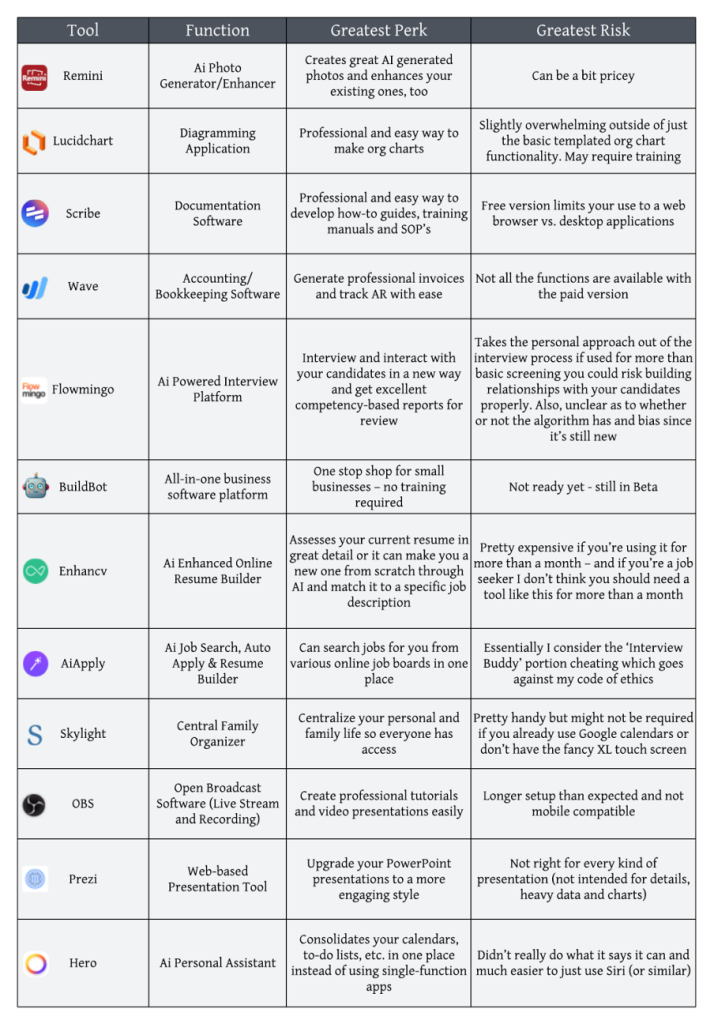
While it’s easy to list the pros and cons of individual products, it’s much more challenging to discuss the overarching ramifications for having tools like this available at our fingertips without properly established frameworks and principles. After all, these tools can be powerful, and thanks to Peter Parker we all know that “with great power, comes great responsibility”.
In his online course on Ethics in the Age of Generative AI, Vilas Dhar discusses the importance of responsible data practices, well-defined boundaries/safe & appropriate use protocols as well as robust transparency being the critical components for all ethical AI tools. "Any new technology is only as ethical as the underlying data that it's trained on".
What does this mean? Ask questions. Lots of questions. For example, "what is the source of the training data" and "how might the data be used to perpetuate historic bias". We also need to keep in mind the traceability of the outcomes the tool is providing. Think of it this way; most people intuitively understand that effective problem solving involves asking a question, formulating a hypothesis, conducting an experiment and then analyzing the findings. In this case, asking yourself how the tool arrived at its output is a very critical, human-driven part of the audit process. You need to be able to ask the tool to "prove it" in a way that makes sense to you.
As technology continues to evolve at such a rapid pace, we are fortunate to rely upon organizations such as UNESCO that are responsible for establishing AI ethics standards based on fairness and human rights. Similarly, CAIDP "aims to promote a better society...a world where technology promotes broad social inclusion based on fundamental rights...". Although Canada was one of the first countries in the world to propose law to regulate AI, sadly, Canada still does not currently have a regulatory framework specific to AI. As stated on the Government of Canada website, although some regulations exist in specific areas regarding certain uses, there is no regulated approach that addresses systematic risks during the design and development stages of the process. While my 12-day challenge was enlightening, it's clear that the real challenge is still ahead. As we enter a new calendar year, I look forward to staying curious, asking questions and being an active participant in helping our world develop and use technology both for the better and for good (that one's for all you Wicked fans out there).
(original article posted on Dec 31, 2025)